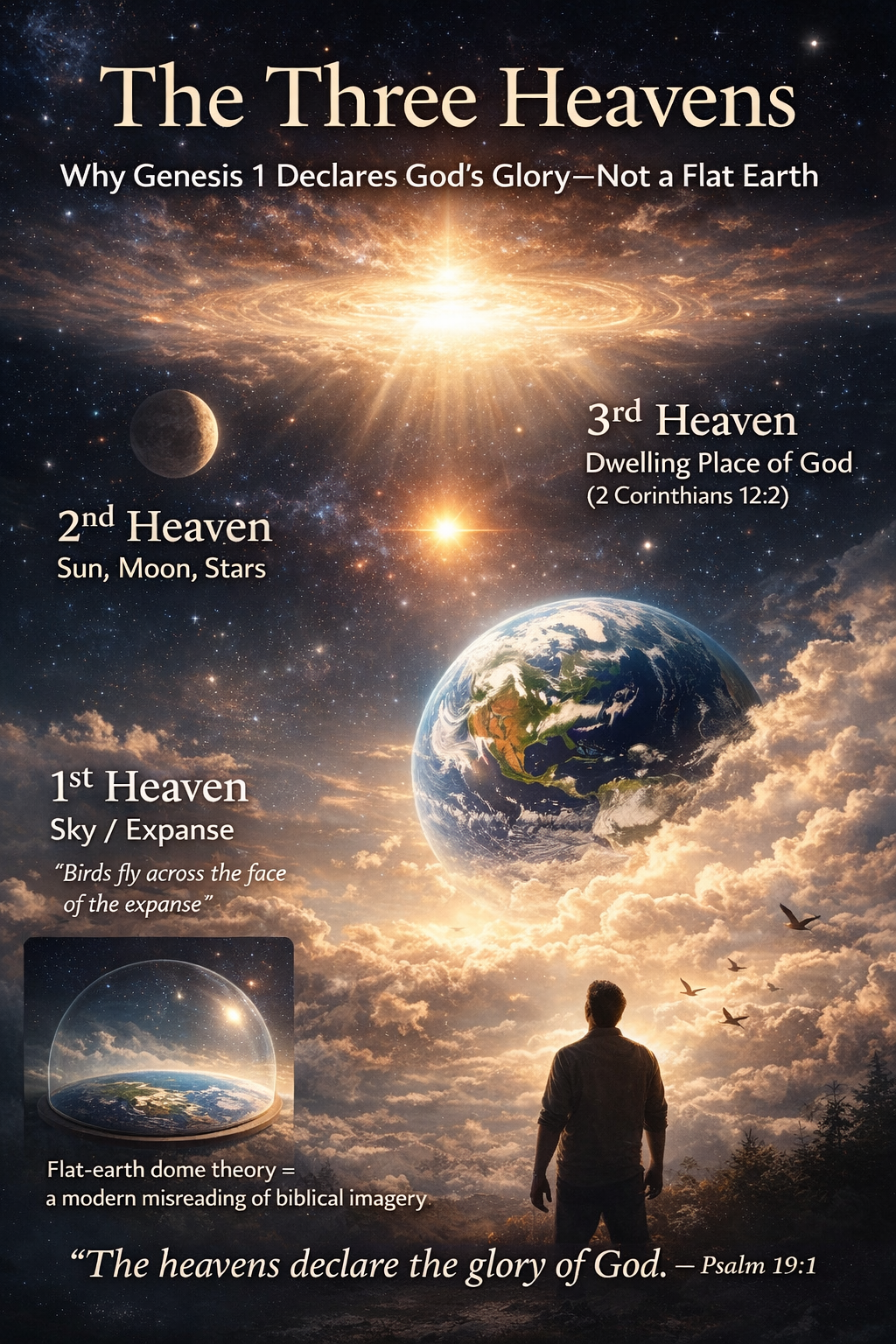
The Firmament and the Three Heavens
If things go as planned, Artemis II will launch today for a slingshot around the moon—and I, for one, have been watching every detail of this mission with the wide-eyed wonder of a child. There is something irreducibly majestic about the thought of human beings arcing through the void toward that pale light God hung in the sky on the fourth day of creation (Genesis 1.16). The heavens really do declare His glory, and every rocket we launch is just one more way we strain upward to hear the declaration (Psalm 19.1).
Yet when I turned to social media, the wonder curdled. Amid the usual skeptics—I had a grandfather who believed the moon landing was faked, so I am not easily rattled—I found a louder, stranger chorus: professing Christians insisting the earth is flat, that the firmament of Genesis 1 is a solid dome no spacecraft could penetrate, and that the very concept of a globe hurtling through space is satanic. One young man told me exactly that.
I cringed. Not because honest questions about Scripture embarrass me, but because I know how this sort of brazen eisegesis reflects on the community of believers. When we force the Bible to say what it never intended, we do not honor it—we obscure the far greater truth it actually proclaims.
The Firmament Is Not a Dome
One of the most common mistakes in reading Genesis 1 is assuming that every mention of “heaven” or “the firmament” must refer to the same thing in the same way. The Hebrew word raqia is better rendered “expanse”—an open, stretched-out space, not a metallic shell. God Himself asks Job, “Can you, like him, spread out the skies, hard as a cast metal mirror?” (Job 37.18, ESV). The poetic comparison only works if the sky is not ordinarily thought of as metal; the wonder lies in the contrast.
Notice, too, that Genesis 1.20 places birds flying “across the face of the expanse of the heavens” (ESV). If the firmament were a hard dome, birds would not fly across its face—they would crash into it. The text describes the open sky as human beings experience it whenever they tilt their heads upward.
Three Heavens, One Creator
Scripture speaks of “heaven” in more than one sense, and Paul makes this explicit when he writes, “I know a man in Christ who fourteen years ago was caught up to the third heaven” (2 Corinthians 12.2, ESV). His wording assumes a framework any Jewish reader would have recognized.
The first heaven is the atmospheric sky—the realm of clouds, wind, and weather, what Ecclesiastes calls the place where “the clouds return after the rain” (Ecclesiastes 12.2, ESV). The second heaven is the celestial realm—the theater of sun, moon, and stars that Genesis 1.14–17 describes as lights set “in the expanse of the heavens.” The third heaven is the dwelling place of God Himself, the realm that Solomon confessed could not be contained even by “heaven and the highest heaven cannot contain” (1 Kings 8.27, ESV; cf. Nehemiah 9.6; Psalm 148.4).
Paul was not speaking of traveling further upward in a merely physical sense, as though the throne room of the Almighty were just one more layer beyond the stars. He was caught up into the presence of the living God—a reality so overwhelming that he heard “things that cannot be told, which man may not utter” (2 Corinthians 12.4, ESV).
Description, Not Specification
The deeper problem with modern flat-earth readings is that they confuse biblical description with scientific specification. Scripture consistently employs the language of appearance and experience. We still do the same: we say the sun “rises” and “sets” without meaning it literally circles the earth. The biblical writers describe the world as seen from the vantage point of ordinary human life—and Isaiah even speaks of God sitting “above the circle of the earth” (Isaiah 40.22, ESV), a phrase that the flat-earth reading cannot comfortably accommodate.
When Genesis speaks of the heavens, it is not handing us a cosmology chart. It is doing something far more significant: declaring that God created, ordered, and rules every realm—whether the sky above us, the stars beyond us, or the Heaven where He dwells in unapproachable light (1 Timothy 6.16).
The Greater Glory
Here, then, is the truth the passage means to press upon the human heart. The same God who stretched out the atmospheric heavens like a curtain (Psalm 104.2), who calls every star by name (Isaiah 40.26), who sits enthroned above the circle of the earth—that God is not threatened by a rocket launch, and He is certainly not hiding behind a dome. He is the Maker of heaven and earth, and His glory fills every heaven there is. Artemis II will prayerfully make a safe transit of the moon. But long before any astronaut sees the far side of the lunar surface, the psalmist already knew the only thing that finally matters: “The heavens declare the glory of God, and the sky above proclaims his handiwork” (Psalm 19.1, ESV). Let us not trade that magnificent declaration for a conspiracy theory about domes and flat earths.