The Craftsman’s Temptation
I must admit a weakness. I am easily drawn to restoration videos — those small digital parables in which a skilled pair of hands takes something rusted, seized, and forgotten and brings it back to life. There is joy in watching neglect be reversed, and it is not a shallow pleasure. Something in us recognizes it as a faint echo of a deeper process. We see corrosion removed and color restored, and for a moment we feel — perhaps without naming it — that this is what should happen to broken things.
But the videos do not always end as they should.
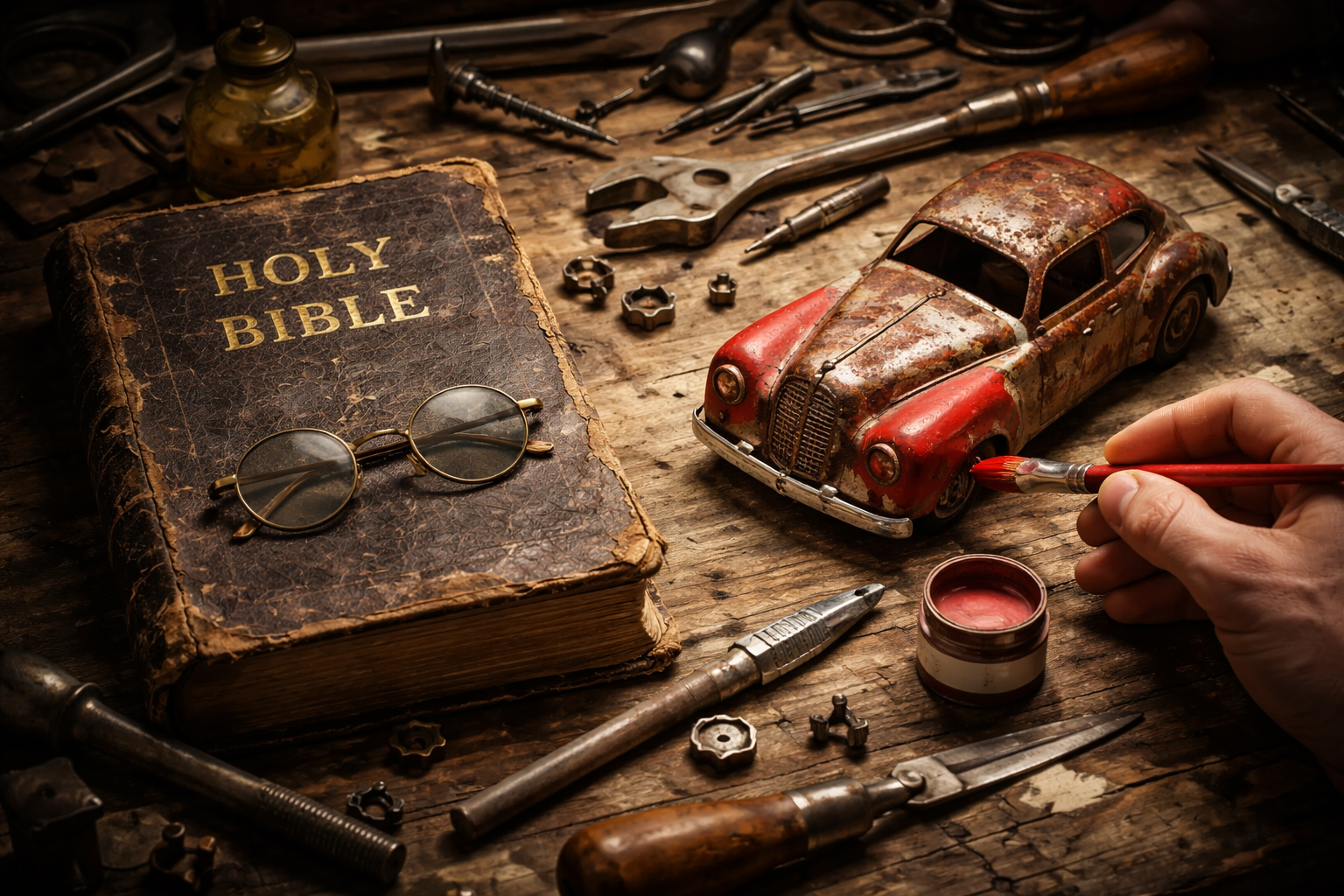
The craftsman starts off well. He is careful, precise, and even respectful. He takes apart each part, soaks the rusted joints, and releases the frozen mechanisms. You watch him work on small things — a bent lever, a cracked housing — and you admire his patience. But then, at the final step, something changes. He reaches for the paint, and the color he picks is not the same as the one the object had when it left the factory. It’s something newer. Sleeker. More to his taste.
And with that single choice, the entire project changes its nature.
What was once restoration becomes renovation. What was an act of fidelity becomes an act of taste. The object may now function. It might even appear better by certain standards. But it is no longer what it was. It has been transformed into something the craftsman preferred, and the original purpose has been quietly set aside.
Now, you might say this is a trivial matter — just a question of paint on metal, hardly worth making a fuss over. And if we were only talking about antique fans and vintage clocks, you’d be correct. But I believe we’re dealing with something entirely different.
The Harder Faithfulness
Not every craftsman succumbs to this temptation. Some approach their work with a completely different attitude — not as improvers, but as servants of the original design. If a screw shears during disassembly and no replacement can be found on any shelf or in any catalog, they will craft one by hand. If the original finish is obscure, if the paint formula has been out of production for decades, they will research it, test it, fail, and try again until they succeed. Their labor is not merely skilled; it is wholehearted. They do not ask, “What would I prefer this to be?” They ask, “What was this made to be?” and then they do whatever is necessary to honor that purpose.
That distinction — between preference and pattern, between creativity and fidelity — is not just an interesting contrast. It is, for those of us who care about the church of Christ, an urgent matter.
The Real Restoration
The Restoration Movement had a clear and costly purpose: to return to the New Testament pattern. It was not about improving Christianity or modernizing it, but about removing the human traditions and innovations that had accumulated and restoring what the Lord Himself established. The goal was never to create something new; it was to go back to its origins.
And yet the same temptation that visits the craftsman visits us.
It begins, as temptations often do, with something that feels reasonable. A practice is adjusted here, an element introduced there — not because Scripture commands it, but because it seems effective, appealing, or simply more comfortable for the age we live in. The intention may be entirely sincere. The reasoning may sound prudent. But the result, if we’re honest, is the same as when the craftsman reaches for the wrong color of paint. The object may still function. It may even attract admiration. But it is no longer a restoration. It has become a reinterpretation — and those are not the same thing, no matter how much we might wish them to be.
Here is a practical test, and one that every congregation and Christian should consider: When we make decisions about worship, practice, or the direction of the church’s life, what question are we really answering? Are we asking, “What do we prefer?” or are we asking, “What did the Lord establish?”
The first question will always give us an answer that flatters us. The second may not. It might require us to set aside what’s convenient, to abandon what’s popular in our culture, and to do hard work with the text when we’d rather take a shortcut. But the second question is the only one that leads to real restoration.
Small Details and Great Reverence
Someone might argue that this focuses too much on trivial details. Are we really supposed to worry over minor points when the overall structure is sound? But think of the craftsman who fabricates the missing screw. He doesn’t do it because the screw is an extraordinary object in itself. He does it because he refuses to compromise the integrity of the whole. He recognizes that faithfulness isn’t only shown through grand gestures. It’s demonstrated in the willingness to get the small things right, precisely because they are part of the original design.
So it is with us. Every effort to follow the pattern God has provided — no matter how small or demanding — is an act of reverence. It is a way of expressing, through our choices and not just words, that His design is enough. That we don’t need to improve on it. That we trust the Designer more than we trust ourselves.
And make no mistake: that trust will be tested. It is not difficult to follow a pattern when it aligns with our preferences. The real challenge arises when it doesn’t — when obedience demands something we wouldn’t choose, and faithfulness feels like a restriction rather than a liberation. It is exactly in that uncomfortable space that true restoration takes place.
Two Paths, One Question
When you compare the two approaches — the craftsman who paints based on his taste and the craftsman who paints based on the original — the question they raise isn’t complicated. It’s simply this: Who is the work for?
If it is for the craftsman, then his preferences are the standard, and any result that pleases him is a success. But if the work is for the sake of the thing itself — for what it was designed to be — then the craftsman’s preferences must yield, and the original pattern must take precedence.
The church does not belong to us; it belongs to Christ. Its pattern was not left to our judgment but was given by the Spirit through the apostles, recorded in Scripture, and preserved for every generation that humbly receives it. Our task is not to reimagine it; it is to return to it.
Anything less might result in something that works. It might even create something that draws a crowd. But let us not call that restoration. Restoration isn’t about making something better in our eyes. It’s about returning something to what it was meant to be — and then respecting it enough to leave it there.
That is harder work. It is less glamorous. It will not always win applause.
But it is the only work that honors the Designer.